

Barakah-Based Project Planning for Muslim Builders
A prophetic, phased roadmap to build what lasts without burnout. Map phases, safeguards, and KPIs rooted in barakah.

Why Most Islamic Visions Stall
You’ve got the fire. The du’a. The vision. Maybe even the Google Doc full of ideas that could revive the Ummah if executed well.
And for a while, the energy carries you. You’re dreaming of launching a media platform, an academy, a mentorship program, and maybe even a waqf-based ecosystem, all within 12 months. Because you care. Because the Ummah needs it. Because this feels like your calling.
But a few weeks later, the passion turns to pressure.
You don’t know where to start.
Your to-do list is 47 tasks long.
You’re overwhelmed by your own ambition.
You’re stuck between “Bismillah” and burnout.
Sound familiar?
This is where many sincere Muslims stall. Not because they’re lazy. Not because they’re unskilled. But because they’ve never been taught barakah-based project planning or how to break bold Islamic ideas into doable, spiritually aligned steps.
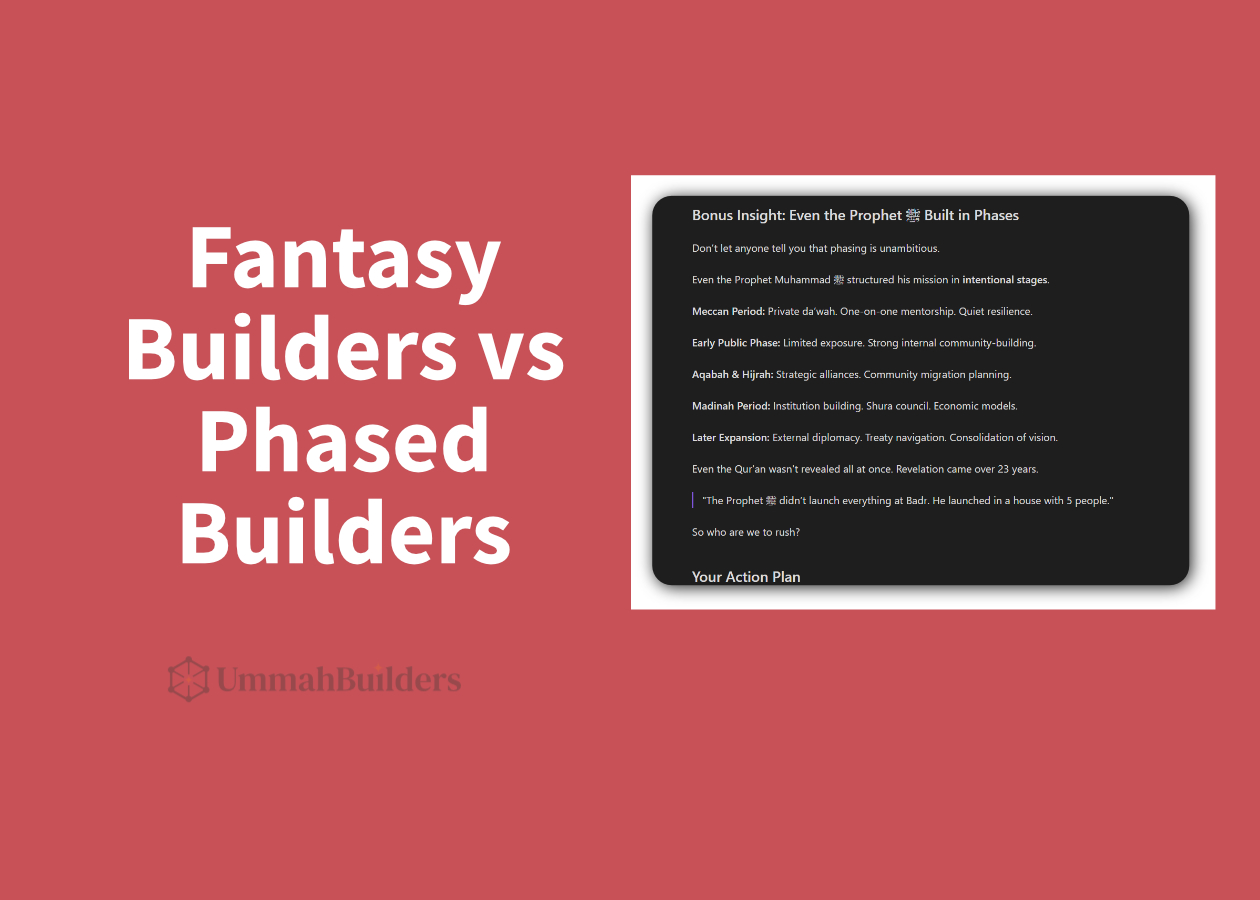
In a world where launch culture screams “build fast or die,” it’s easy to feel behind. But the Prophetic model was different. It was slow, intentional, scalable. The Prophet ﷺ didn’t start with systems, councils, or campaigns. He started in a house with five believers, and built from there.
It wasn’t about doing everything at once. It was about doing the right thing at the right time, with the right intention.
If you’ve ever felt crushed under the weight of your own vision, this article is your lifeline. You’ll learn how to design a step-by-step Islamic project roadmap that honours your sincerity and your sanity. Not by shrinking your dream but by phasing it, like the Prophet ﷺ did.
The Prophetic Model of Phased Growth
In today’s hustle culture, we glorify speed.
But if you look at how the Prophet Muhammad ﷺ built, the word isn’t “fast.” It’s “phased.”
His mission unfolded over 23 years. Not because he lacked resources or clarity, but because divine success is measured by precision, not pace.
This is the essence of prophetic project design. It was deeply intentional, context-aware, and rooted in long-term vision without rushing the rollout.
Let’s trace the phases:
1. Meccan Years (Private Call)
For the first few years, da’wah was secret. Just family and trusted companions. This was foundational, a period of deep conviction-building and personal development. In other words, it was a period of small, steady circles of early believers. No infrastructure. Just depth.
2. Quiet Expansion
Gradual outreach began. Open da’wah. Surah upon surah taught emotional resilience and identity. The team grew, but so did the opposition. This was a period of selective public teaching. Increased personal development. No masjid yet, but hearts were growing.
3. Aqabah Agreements & Hijrah Strategy
Long before hijrah, the Prophet ﷺ engaged in intentional alliance-building. He met with leaders from Yathrib, negotiated terms, and built infrastructure before relocating. We are talking strategic partnerships formation. Pledges making. Migration planning with extreme care.
4. Madinah Nation-Building
Institutions began here: masjid, marketplace ethics, economic model set, the first written constitution of its kind. Everything was built to last, but introduced with intentional sequence.
5. Expansion with Trust
As Islam spread, the Prophet ﷺ didn’t get distracted by hype. He focused on consolidation, character, and ensuring the mission never outpaced the message. Remember letters to leaders. International diplomacy. Clear succession strategies. And the final khutbah wasn’t a launch, it was the handoff of legacy.
What’s the lesson?
Even revelation didn’t come all at once. The Prophet ﷺ didn’t skip stages. He sanctified them.
Every phase was purposeful. The timeline wasn’t rushed. And the transformation stuck. Even when the Ummah got the upper hand at Hudaibiyyah, the Prophet ﷺ didn’t rush it. He chose to wait.
And years earlier in Makkah, he refused the leadership given to him by the Quraish. He could have accepted it and use the power granted to him to force Islam unto others instead of suffering years of persecution.
But had he accepted, he would have gotten so busy with state leadership, he wouldn’t be able to shape the hearts of his followers in such deep manner he eventually did. Alhamdullah he didn’t accept it.
His rejection wasn’t merely strategic. It was the opportunity cost for a spiritual system-building. It showed us that sustainability is sunnah, and overstretching is not barakah.
And perhaps the most powerful metaphor?
Your project is like revelation. It’s not meant to arrive all at once.
It’s meant to descend gradually, shape hearts deeply, and grow through seasons of guidance, not storms of burnout.
So before you try to launch a school, app, podcast, and mentoring program in the same quarter, pause and ask:
Have I clarified my first phase?
Do I have spiritual and structural readiness?
Have I honoured the rhythm of barakah?
When you follow a phased prophetic blueprint, you don’t just prevent unnecessary burnout, you multiply blessing. The roots grow deep. The team builds trust. The outcomes echo longer.
Why Big Visions Fail Without Phasing
You’ve already probably seen it: the passionate founder who launches too fast, tries to do everything at once, and fizzles out within a year. It’s not a failure of sincerity. It’s a failure of barakah-based project planning.
Let’s break down the most common traps Muslim visionaries fall into when they don’t work in phases:
1. Trying to Build Everything at Once
Instead of starting with a pilot Qur’an circle, they draft a global Islamic curriculum, design a school building, and pitch to donors, all before testing the concept. The result? Delay, confusion, and discouragement.
2. Confusing Scale with Success
They believe a broader launch equals more barakah. So they over-extend: launching an app, website, merchandise line, and 3 social channels without support systems. And soon, quality drops across the board.
3. Lack of Strategic Sequence
Without clear sequencing, you build a structure with no foundation. You launch a podcast before you’ve clarified your brand. You release a mentoring program without a team. You open registration without a curriculum. Things collapse under their own weight.
4. Donor Fatigue and Team Burnout
When you pitch ten disconnected offerings to donors, they get confused. When your team juggles too many timelines, they lose focus. The sincerity remains, but momentum dies.
5. Delayed Launch Due to Perfectionism
Many sincere builders wait until everything is “ready.” But readiness is a trap. Phasing says: launch something lean. Build from there.
“The Ummah doesn’t need your perfect vision later. It needs your obedient action now in a form that’s doable, sustainable, and spiritually grounded.”
What works better?
Small experiments. Clear roles. Modest beginnings.
Da’wah studios can launch with a 3-minute video series, no complex editing, just sincerity and clarity. They don’t need a studio. They need a step.
That’s the power of phased thinking:
You don’t dilute your vision. You sequence it for maximum sustainability and minimum burnout.
When your Islamic project roadmap is realistic, you honour both your energy and your intention. And that’s where barakah grows.
Introducing the Phased Timeline Creator
Ambition isn’t the problem. Lack of structure is.
That’s why we created the Phased Timeline Creator, a tool designed specifically for Muslim builders who want to scale their projects with sincerity, stamina, and faith-driven goal setting.
We are not asking you to start creating a rigid business plans. We are talking about designing growth the way the Prophet ﷺ modelled it: in intentional stages, aligned with values and energy levels, not just vision boards.
Here’s what it helps you map:
1. 10-Year Vision, Not 10-Day Pressure
Start by writing down the full dream. Do you want to establish a zakat-powered youth center? Build a Qur’an-first startup culture? Launch a waqf-funded education platform? Capture it... clearly and confidently.
This sets the Islamic project roadmap, even if you’re starting with a blank slate.
2. Strategic Phases (3–5 Milestones)
Break your dream into digestible chunks:
Phase 1: Proof of concept (e.g. pilot program or beta launch)
Phase 2: Early adoption and refinement
Phase 3: Core infrastructure (team, tools, revenue)
Phase 4: Public expansion
Phase 5: Systems and sustainability
Every step builds capacity without compromising barakah.
3. Resources Per Phase
What will you actually need at each stage?
Example:
Phase 1: 1 volunteer, Canva, and a schoolroom
Phase 2: A budget of $300, a survey tool, and a mentor
Phase 3: Part-time admin, Zoom Pro, basic donor CRM
This grounds you. No more fantasy budgets or team dreams disconnected from reality.
4. Metrics of Progress
Instead of just signups, track sincerity. Barakah-based project planning includes:
Strategic KPIs: attendance, reach, budget health
Spiritual KPIs: du’a frequency, team morale, intention check-ins
5. Barakah Safeguards
Design checkpoints to stay spiritually anchored:
Monthly istighfar reflections
Pre-phase istikhara
Team shura over solo decisions
Niyaah reviews every 60 days
Your growth should be as intentional as your prayer, not rushed, not showy, but anchored in presence.
Download the Phased Timeline Creator Worksheet to map your idea into a 5-phase model that’s not only doable, it’s spiritually sustainable.
Example: Muslim Girls Leadership Program
Let’s bring this concept to life.
Say you’re passionate about equipping Muslim girls with leadership confidence, Qur’anic grounding, and a deep love for their identity. You dream of a global academy, branded curriculum, mentorship pipelines, the full package.
But you’re a solo founder. Limited time. Modest resources. What now?
This is where barakah-based project planning changes everything.
Instead of launching the entire ecosystem at once, you break it down, phase by phase, just like planting a garden:
Phase 1: Pilot Planting
Launch a 4-week after-school program at one local Islamic school. 10 students. 2 volunteer mentors. Basic worksheets and reflection prompts. No website. No logo. Just sincere, structured teaching.
Phase 2: Soil Testing
Gather feedback from parents, students, and mentors. Refine the curriculum based on what truly resonated. Create a sharable digital toolkit (PDF + slide deck) for others to replicate.
Phase 3: Community Seeding
Reach out to nearby masjids and weekend schools. Offer free or low-cost “Leadership Lite” workshops using your toolkit. Begin documenting success stories and participant transformations.
Phase 4: Early Bloom
Train your first cohort of local trainers. Develop simple branding. Launch a small web presence.
Start building relationships with potential funders and waqf boards.
Phase 5: Scale with Ihsan
Roll out regionally. Introduce waqf-backed scholarships. Publish a full curriculum with Qur’an + Hadith anchors. Offer trainer certification. Build an alumni network.
By structuring the idea this way, you honour the vision without suffocating it. You serve with clarity, not chaos. You grow with presence, not panic.
Legacy isn’t built through launch hype. It’s built through consistent phases, each with intention, feedback, and ihsan.
Common Pitfalls to Avoid When Planning Big Islamic Projects
When the vision is big, the temptation is real: move fast, launch everything, and figure it out later. But in barakah-based project planning, urgency without clarity can sabotage even the most sincere initiative.
Here are five common mistakes Muslim builders make when trying to launch something meaningful and how to avoid them.
1. Skipping the Pilot Phase
Your idea might be amazing. But without testing it on a small scale first, you risk wasting resources, confusing your audience, or building something that doesn’t meet a real need. Faith-driven goal setting honours proof before pride.
Start lean. Measure impact. Adjust with humility.
2. Launching Too Many Things at Once
It’s easy to get caught in the hype of visionary momentum. A course, a coaching program, a podcast, a newsletter, all at once. But this spreads your barakah too thin.
Instead, sequence wisely. Think one strong stream before branching rivers.
3. Copy-Pasting Corporate Planning Without Spiritual Alignment
Airtight Gantt charts and productivity boards are great. But if they’re divorced from du’a, tawakkul, and sacred intention, they can lead to burnout, not barakah.
Faith-based execution includes istikhara, shura, and checking your niyyah before you check your metrics.
4. Mistaking Busyness for Barakah
A full calendar doesn’t always mean spiritual progress. You might be doing more, but moving further from your purpose.
This is where Barakah Metrics shine. They help you assess whether your effort is truly anchored in impact, not just activity.
5. Overlooking Du’a and Istikhara Before Execution
Prayer isn’t just preparation, it’s participation. A vision without sincere du’a is like a strategy without a soul.
When your plans begin with Allah, the outcomes align more naturally even if they don’t follow your original timeline.
Questions You Might Be Asking About Barakah-Based Project Planning
Q1: What if my vision is too big for the resources I have?
That’s exactly why phasing exists. You’re not meant to fund or execute everything at once. Start with a pilot that proves your concept with what you already have. Allah blesses effort, not just scale.
Q2: How do I keep momentum when results feel slow?
Focus on consistent micro-wins. Use Barakah Metrics to track spiritual and emotional progress, not just numbers. Often, what feels slow is actually solid foundation-building.
Q3: What should I do before starting Phase 1?
Make sincere du’a. Consult people of knowledge and experience. Perform istikhara. Define your intention in writing. Start with clarity not just hype.
Q4: What’s the difference between a strategic phase and a to-do list?
A phase includes a purpose, outcomes, resources, and barakah safeguards. A to-do list is a set of tasks. Phases create movement. Lists just track activity.
Q5: How do I explain phased planning to donors or team members who want “big impact now”?
Share the Prophetic example: slow, strategic, spiritually anchored growth. Remind them that rushing results can sabotage barakah. Use past successes as proof of your phased method’s power.
Q6: Can I use this process for personal goals, not just team projects?
Absolutely. Barakah-based project planning works for personal dreams, Islamic education goals, side hustles, and community initiatives. The framework is flexible, but the mindset is everything.
Final Reflection: Allah Blesses Effort, Not Fantasy
You’re not behind. You’re not failing. You’re not underqualified.
You just need a plan that honours the way barakah really works through phased progress, not perfect blueprints.
The Prophet ﷺ didn’t build the Ummah overnight. He started in a house. With a few believers. Quiet, deliberate, sincere. Each stage built on the last. Each move shaped by du’a, shura, and trust in Allah’s timeline.
You are part of that legacy. Not by launching everything now, but by moving with niyyah, structure, and sabr.
So grab your Phased Timeline Worksheet. Design what you can carry. And walk your vision one small, sincere step at a time.
Because barakah doesn’t rush. It roots. And then it rises.
Allah sees your quiet work. Keep going.
Teslim
— The UmmahBuilder
We’re not fundraisers. We’re system builders.
Previously in This Series:
Metrics of Barakah: How to Track Spiritual Impact, Not Just Numbers
Coming Next Week:
The UmmahBuilders Roadmap: How to Tie It All Together Without Losing Steam (coming soon)
Want to follow the full journey?
View all UmmahBuilders articles in order: How to Build the Ummah Series
Don’t miss the next article.
Subscribe to get it delivered directly to your inbox → Subscribe Now