

The Spiritual Infra Layer: Designing Systems That Deliver Barakah, Not Just Outcomes
Why Your Systems Feel Hollow — and How to Rebuild Them

You’ve built the system. The team meets every week. The project launches on time. The branding looks polished. The deliverables arrive exactly as planned.
And yet… something feels off. Not wrong. Just empty.
You can’t quite put your finger on it, but somewhere between the spreadsheets, strategy decks, and volunteer rosters, the barakah has slipped out the back door.
“We’ve done all the right things. Why does it feel so dry?”
This is the silent pain point of many Islamic organizations today. They’ve mastered logistics, outreach, onboarding, and metrics, but overlooked the spiritual infrastructure that once made Islamic work an act of worship, not just effort.
A Qur’an class runs like clockwork, but no one’s heart is moved.
A fundraising campaign hits its goal, but leaves the team spiritually depleted.
A da’wah podcast trends online, but the hosts haven’t made time for tahajjud in months. With no spiritual transformation in themselves nor in the listeners.
We’ve inherited Islamic systems thinking, but often through a secular lens.
We’ve chased operational success without asking if our systems are Qur’an-aligned or rooted in prophetic project design.
This issue is about rebuilding from the inside.
We’re going to explore what it means to create spiritually aligned Islamic systems, ones that integrate purpose-first organization models, maqasid-driven workflows, and sacred operational models into your everyday work.
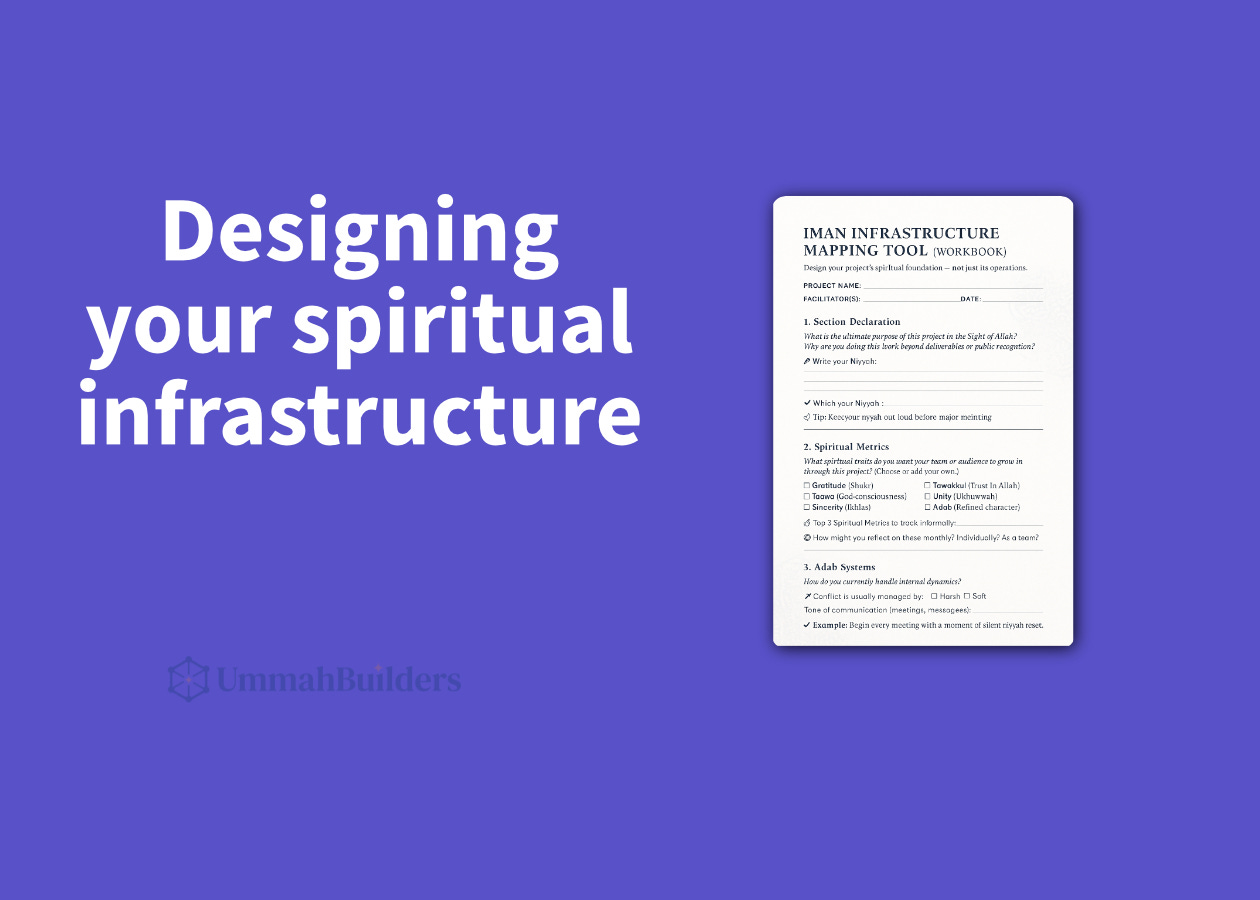
You’ll also get a practical tool, the Iman Infrastructure Mapping Worksheet, to help you start layering dhikr, niyyah, and ihsan into your existing systems without burning them down.
The Prophet ﷺ designed an environment where hearts were refined and teams were rewarded in both worlds. We need to learn from this.
That’s what your work can become, if the foundation is spiritual.
When Systems Work But the Soul Feels Left Behind
The trap of Islamic systems thinking that mimics corporate models but forgets Qur’anic values is real.
We optimize for output. But we forget maqasid-driven workflows that account for the unseen: sincerity, presence, and intention. And while there’s nothing wrong with building efficient structures, something’s off when sacred operational models are replaced by hustle culture dressed in Islamic branding.
Take the example of a Qur’an school where teachers arrive on time, classes run efficiently, and reports are filed. But behind the scenes:
Salah is rushed to meet class times
Teachers feel disconnected from one another
No one is checking in on the spiritual well-being of the staff
We are just doing for no purpose, or other purposes than that of seeking Allah’s rahma.
These are signs of purpose-first organisation models that have lost their centre.
And the results aren’t just emotional. They’re spiritual. Barakah thins out. Burnout creeps in. And the work, while technically “Islamic,” starts to feel hollow.
What’s missing?
A spiritual infra layer, an intentional design of internal alignment with Allah, built directly into your systems. That is why most Islamic organisations’ work is no different from their non-Islamic NGOs.
Let’s explore what that layer looks like in action and how it transforms what you build and how you build it.
What Is the Spiritual Infra Layer and Why It Powers Barakah
Every lasting system has a foundation. But spiritually aligned Islamic systems are different and they’re built not only to function but to elevate the soul.
The Spiritual Infra Layer is that unseen scaffolding beneath your workflows. It is the heartbeat that keeps everything connected to Allah.
It does more than replacing structure with spirituality. It weaves the potential for barakah into your planning, compassion into your systems, and Qur’anic intention into your daily processes.
To clarify who your system is built for, read the Build Your Ummah Avatar before planning your workflow.
Here’s what that looks like in real life:
A da’wah team that opens every planning session with a sura such as Surah Al-Asr, reminding themselves of time and accountability. And they do so with deep reflections and humility, not just foe performative purpose.
A mentorship circle where leaders meet monthly to reflect on how they’re growing, not just what they’re delivering. They help each other strengthen their hearts through the work they do. They are not just content with doing. They want to see real change.
A fundraising team that pauses at key milestones to make du’a for tawfiq, instead of just checking KPIs. They are blunt with each other to protect themselves from misusing the funds under the cover of Islam. They are fully aware that even though they don’t see Allah, He sees them, and knows what they are doing with the funds kept under their trust.
A dawah institution where every activity is planned around salah time, putting the constant obedience and remembrance of Allah at the forefront of whatever they are doing irrespective of the importance attached to it.
In fact, these aren’t “extras.” They are the architecture of faith-based systems design.
In prophetic project design, how you operate matters just as much as what you accomplish. The Prophet ﷺ assigned tasks to his sahabas only after he had nurtured the hearts of those who would carried them out. He built trust. He infused purpose. And to keep them spiritually grounded, he ended meetings with dhikr (remembrance of Allah).
If your project is running smoothly, but the soul feels absent, it’s time to map your iman infrastructure with intention.
Let’s look at the signs your current systems might be missing this essential layer, and how to begin realigning.
Signs Your Systems Are Missing the Spiritual Infra Layer
You can have an efficient team, a polished program, and a packed calendar and still sense that something’s off.
That “off” feeling isn’t always burnout. Sometimes, it’s the quiet absence of barakah. It’s what happens when we prioritise speed over sincerity, checklists over connection, and outcomes over intention. It’s what leads to the exodus of sincere and trustworthy team members, even when you find reasons to justify their departure.
Here are five real-world signs your system might lack Qur’an-aligned infrastructure:
1. Everything Feels Rushed
Meetings are tight. Emails are transactional. You get things done but no one feels nourished by the process. There’s no pause for solah, reflection, du’a, or gratitude. Just output.
2. Team Morale Is Drifting
Your volunteers or staff might be performing, but internally, they’re drifting. They start missing meetings or even hating it, resenting requests, or questioning why they joined.
3. Conflicts Escalate Fast
Without a shared spiritual compass, minor issues turn into major disputes. Adab breaks down. There’s no sacred language guiding correction or disagreement. Backbiting becomes a norm, and people are judged in their absence.
4. Spiritual Growth Isn’t Part of the Conversation
You focus on KPIs, budgets, and timelines, but no one asks: “How is this work affecting our hearts?” There’s no built-in process for internal alignment.
5. Good Work Feels... Hollow
You hit milestones, publish content, or run events and still feel spiritually disconnected. You begin to question whether the reward is actually reaching you. And you take solace in external metrics (money raised, awards collected, invitations, etc)
These are not signs of failure. They are signals calling you to reintroduce sacred operational models.
And you don’t need to overhaul everything. You just need to begin intentionally with one small layer of alignment at a time.
That’s why we created a practical tool: the Iman Infrastructure Mapping Worksheet. Let’s explore what it covers and how to use it to begin building barakah back into your system.
Designing Spiritually Aligned Systems: Inside the Iman Infrastructure Mapping Tool
Most Islamic projects have a team lead, a WhatsApp group, and a task list. Fewer have a workflow that raises hearts while it gets things done.
That’s where the Iman Infrastructure Mapping Tool comes in.
It’s not a productivity app. It’s a reflection tool designed to help you embed the unseen spiritual architecture into your system, so the outcome is not just efficient, but eternally aligned. It’s simple and may look negligible, But it’s powerful.
Here’s how it works:
1. Niyyah Declaration
Start with who you’re building for, not your audience, but your Creator.
What is the akhirah-facing reward you’re seeking?
Whose pleasure are you optimising for?
Can you tie your project to a specific ayah, hadith, or prophetic mission?
For example: A da’wah group might ground their work in Surah Fussilat 41:33 — “Who is better in speech than one who calls to Allah…”
And their reflections over its meaning guide their efforts and relationship among themselves as well as others.
See From Maqasid to Models for aligning your goals with higher spiritual outcomes.
2. Spiritual Metrics
Most teams track logistics. Few track transformation.
Ask:
Are we increasing in gratitude?
Are team members becoming more present in salah?
Are we promoting humility, not hype?
Are we sincere to ourselves and in our actions
Beyond the numbers, give top priority to your internal states.
The Quran clearly warns about this in Surah Al-Baqarah 2:44 — “Do you preach righteousness and fail to practice it yourselves, although you read the Scripture? Do you not understand?”
3. Adab Systems
Every Islamic project has conflicts, mistakes, moments of tension.
The question is: How do you handle them?
Do you correct with compassion?
Are your team chats sarcastic or sincere?
Do you delegate with amanah or control?
Do you notify team members immediately when they do wrong?
Do you avoid backbiting team members?
Adab is your etiquette and spiritual brand.
4. Spiritual Checkpoints
Every system needs scheduled reminders of the why.
Do you open meetings with a renewal of niyyah and du’a?
Is there a monthly team reflection or gratitude round?
Does someone lead a short dhikr in retreats or offsites?
Do team member take dhikr seriously, or is it taken as unnecessary?
Build rhythms of remembrance into the mechanics of your work. Dhikr is how you stay connected with Allah continuously. It is your direct communion with the Almighty. Normalise reciting the recommended dhikr to keep nurturing your heart.
5. Team Iman Culture
What happens when your best volunteer is feeling low?
Do they get grace or guilt?
Is there space for iman check-ins?
Do leaders model vulnerability and faith?
This is the difference between a productive team and a sacred team.
When these five areas are mapped, your system transforms from transactional to transcendent.
Let’s see what this can look like using a hypothetical weekend Qur’an program that restructured itself through this exact lens to achieve a subtle, and profound result full of barakah.
Barakah in Practice: How A Qur’an Program Can Transform Its Spiritual System
Let’s take this off the whiteboard and into the masjid.
Imagine you run a weekend Qur’an class for teens. You’ve got committed teachers, a structured syllabus, and parents who want results. But something’s missing.
The students memorise, but their hearts don’t connect. The teachers teach, but feel spiritually dry. The system works but the souls aren’t growing.
This is what happens when your operations are strong… but your spiritual infra layer is thin.
Here’s how a team can rebuild their Qur’anic infrastructure using spiritually aligned Islamic systems:
Before the Shift
Class started at 9:00 sharp — no intentional warm-up
Teachers taught and left — no team bonding or feedback loops
Students memorised mechanically — low retention, low emotional connection
Meetings were purely logistical — focused on attendance and timetables
After Applying the Iman Infrastructure Map
Niyyah Realignment
The team chooses a unifying intention: “to raise youth who recite Qur’an with both tongue and heart”
They add an ayah to their curriculum header: “Verily, this Qur’an guides to that which is most upright…” (17:9)
Spiritual Checkpoints
Each class begins with a 2-minute collective niyyah reset led by a different student
Teachers arrive early for quiet du’a and a brief team reflection
Adab & Culture
Feedback shifts from correcting tone to uplifting effort
A student “akhlaq tracker” is introduced alongside tajwid scores
Team Iman Culture
Monthly teacher meetups includes a personal “how has this work changed you?” session
The admin adds a reflection section to reports: “Where did you see barakah this month?”
Parental Engagement
Instead of only sending grade updates, parents receive monthly “Qur’an & Character” summaries
What Changes?
*Retention improves — students feel emotionally invested
*Teacher morale increases — they feel spiritually nourished
Curriculum slows down — but understanding deepens
Parents feel inspired — not just informed
They build a Qur’an culture through class.
This is the subtle power of maqasid-driven workflows. Systems that serve both the soul and the schedule.
Building Spiritual Systems in Secular Spaces:
Whether you’re working in a public school, hospital, or interfaith team, you can still apply spiritually aligned Islamic systems subtly. Embed mercy, intentionality, pauses for reflection, and Qur’anic ethics into how you lead, even if you can’t use overt Islamic language.
Now let’s look at how the Prophet ﷺ modelled this integration, where even leadership and logistics were shaped by revelation, intention, and heart-aligned structure.
The Prophetic Blueprint: Systems That Purify While Performing
The Prophet Muhammad ﷺ did more than leading with charisma.
He led with what I call sacred operational models that balanced function with faith. Every act of leadership from war planning to family guidance was infused with Qur’anic system design and spiritual consciousness.
He didn’t separate systems from sincerity. He delegated efficiently. It was a prophetic project design in motion.
Here’s how his spiritual infra layer showed up across leadership:
1. Every Meeting Was Bookended With Worship
He opened with du’a, closed with dhikr. Not just mechanically but with full presence and intention.
The purpose-first organisation model wasn’t a productivity hack, it was a barakah magnet.
Even moments of strategy were treated as moments of connection with Allah. Every act was considered as Ibadah for the sake of Allah.
2. Communication Was an Act of Ibadah
His tone changed based on the recipient: firm with oppressors, gentle with seekers, light with the young.
He knew the spiritual temperature of every moment and adjusted accordingly.
He was always aware of his environment. An attitude that helped him combine systems thinking with empathy at its core.
3. Leadership Was Designed to Uplift Iman
He chose governors and representatives based on a combination of skills and sincerity.
He made decisions based on long-term spiritual outcomes not quick wins.
The maqasid (higher purposes of Shariah) always sat behind the process, not just to please people but Allah.
This is your blueprint.
If the Prophet ﷺ designed workflows that guided hearts while governing lands, we too must rethink how we lead, plan, and build.
You can’t claim to follow his model if your systems exhaust the body and starve the soul.
So let’s take that example seriously.
The Builder Challenge
It’s not enough to believe in spiritually aligned Islamic systems. You have to build them into your day-to-day.
Here’s a simple but transformational challenge for you:
Step 1: Download the Iman Infrastructure Mapping Worksheet
This 1-page worksheet helps you define your:
Niyyah anchors
Internal spiritual metrics
Adab culture practices
Team Iman support strategies
Qur’an-aligned infrastructure habits
It’s your step-by-step guide to applying faith-based systems design to your project or organisation.
NB: If you downloaded the worksheet for any of the previous articles in the series, you might already have access to this worksheet too. Check the notion doc you downloaded, you’ll find it there.
Step 2: Choose One Element to Implement
Don’t wait until your whole system is spiritual. Start with a micro-shift:
Add a 60-second niyyah reset to all team calls or meetings
Build a daily dua habits for your team members even if its of one minute (without anyone knowing)
Reflect on one relevant Qur’anic ayah as a group during meetings
Add “Iman Reflections” as a standing agenda item to help each other with their state of the heart.
Use silence and stillness as sacred tools, not awkward moments (helps you with khushu’, i.e. mindfulness in the presence of Allah)
These are not decorative. They are divine disruptions that recalibrate the soul in the middle of the mission.
Step 3: Ask This to Your Team (or Yourself)
“Does this project nourish our iman — or just demand our time?”
And whatever your spoken answer is, only you know the truth because it is not just in speech, but in how you sincerely feel.
If the answer leans toward exhaustion, it’s time to build better spiritual scaffolding. Systems that don’t just run well, but run toward Allah.
Small changes create spaciousness. One Qur’an-aligned meeting ritual can transform your team culture. One reminder of tawakkul can reset your operational pace. One quiet pause before decisions to connect with Allah can boost your khushu’ level in ways no budget can buy.
And that is the secret:
Sacred systems will support your people and sanctify the work you do itself.
Founder Self-Audit:
Ask yourself: “Is this system making me more conscious of Allah or just more productive and popular?”
If the answer leans toward exhaustion or pride, it’s time to realign. Spiritual systems begin with spiritually aware leaders.
Questions You Might Be Asking Yourself About Spiritually Aligned Islamic Systems
Q1: How can I apply this if my team isn’t religiously strong?
Start small. Build on universal values like reflection, purpose, compassion. Avoid overt religiosity. Let your adab be the da’wah.
Q2: What if my leadership resists spiritual changes?
Begin with benefit. Share how spiritual systems improve morale, reduce burnout, and align with long-term impact, not just reward. If smart people have been convinced on the power of meditation, I believe they will find spiritual changes much more powerful.
Q3: Can this work for online-only teams or solo creators?
Absolutely. Use WhatsApp to send sincere du’a and reminders to individual team member, voice notes for Qur’an reflections, and embed dhikr into your digital routines and encourage everyone to do so from time to time.
Q4: How do I balance deadlines with dhikr?
Make dhikr a checkpoint, not a distraction. Begin deadlines with tawakkul du’a. End with gratitude, even if incomplete.
Q5: What if I feel like I’m the only one carrying the spiritual weight?
Lead by quiet example. Share your tools. Invite, don’t impose. Even one aligned heart can shift a team culture over time.
Q6: Should I use Islamic language in secular settings?
Context matters. Infuse values like mercy, ihsan, presence, and trust without needing labels. Let your ethics point to your intention.
Common Mistakes in Spiritual System Design
Forced religiosity: Turning every meeting into a khutbah can backfire. Spirituality must invite, not impose. Avoid ghuluw (exaggeration) in your spirituality. Stick to recommended du’a and adhkar.
Checklist spirituality: Repeating du’a without reflection becomes ritual, not transformation.
Burnout sanctified: Equating exhaustion with piety. True ihsan includes rest and mercy. Don’t neglect your other responsibilities. Be moderate in everything you do.
Final Reflection
The Qur’an wasn’t revealed in one document drop. It was delivered over 23 years verse by verse, moment by moment, responding to the needs of real people, in real situations, with spiritual precision.
That is Qur’anic system design in action: Gradual. Strategic. Soulful.
And it models something essential for us as UmmahBuilders:
Your systems can be sacred if they are built with Allah in mind.
That means intention must lead implementation. Reflection must accompany reporting. And barakah must be prioritised above bandwidth.
To the UmmahBuilders, efficient workflows means nothing if they are not spiritually aligned as Islamic systems that make people feel the presence of Allah in their day-to-day work, whether it’s da’wah, teaching, management, video recording and editing, or services.
So what does this look like practically?
A zakat program that prioritises real changes in people, not just data.
A curriculum that builds taqwa, not just academic excellence.
A social media team that pauses for prayer, not just focused on metrics.
A non-profit board that chooses Qur’anic priorities and the 5 essential Maqasid over prestige projects
These are not idealistic dreams. These are faith-based systems designs that protect your mission from becoming just another hustle.
Build remembering Allah, and He will remember you in your work.
So when your team gathers this week, ask:
What do our systems glorify?
Speed? Status? Survival?
Or sincerity. Stillness. Sacred success?
If you’re doing the work of the Ummah, your systems must serve the soul, not just the spreadsheet, your ego or bank account.
And that begins now.
May Allah put light in your calendars, barakah in your plans, and reward in your every checklist.
May your work become ibadah, your systems a means of tawakkul, and your legacy one that is seen in both worlds.
Teslim
— The UmmahBuilder
Outcomes impress. Barakah transforms.
Previously in This Series:
Institutions That Outlive You: How to Build What Serves the Ummah Long After You’re Gone
Next :
Economic Engines for the Ummah: How to Move from Charity to Autonomy (coming soon)
Want to follow the full journey?
View all UmmahBuilders articles in order: How to Build the Ummah Series
Don’t miss the next article.
Subscribe to get it delivered directly to your inbox → Subscribe Now